



Not every rug is meant to stay on the floor. And not every rug made for the floor belongs only underfoot.

The idea of hanging a rug on the wall, using it as textile wall decor, is not a contemporary invention or a passing trend. It is an old practice: from medieval tapestries in European courts to textiles used inside Saharan nomadic tents, vertical textiles have long had a decorative, insulating and narrative role.
Today, we see them in galleries, design showrooms, collectors’ homes and, more and more often, in living rooms where a printed picture would simply not do the same job. A Moroccan rug, a graphic kilim or a colourful Boucherouite can bring real texture, handmade warmth and tactile presence to a wall.
This guide is a starting point to understand why you might hang a rug, which rugs work best on a wall, where to place them room by room and, only then, how to hang them without damaging either the rug or the wall.
Because hanging a rug on the wall is not just about choosing an unusual decoration. It means treating textile craftsmanship vertically, as you would a work of art, a piece of wallpaper or a textured surface. And it works when proportion, placement and the right hanging method are considered together.
Wall rug or tapestry: is there a difference?
When we talk about a rug hanging on the wall, the word tapestry is often used as a general synonym.
The two terms, however, do not mean exactly the same thing.
A tapestry, in the historical and technical sense, is a textile piece made to be hung. Its weave is designed to be viewed from the front, and it often depicts narrative, mythological or historical scenes. Flemish tapestries from the sixteenth century, or the works produced by the Gobelins manufactory in Paris, are the classic reference: large textile panels commissioned by courts and churches, where pictorial composition and weaving technique were inseparable.
A rug, on the other hand, is made for the floor. When it is hung, it can take on a similar decorative function to a tapestry, but it brings with it a different construction: knot density, fibre strength, pile height and backing are all designed to withstand use underfoot.
A brief historical note: why textiles have been hung on walls for centuries
Hanging textiles on walls is not a contemporary invention. In Europe, tapestry production developed from the early fourteenth century, particularly in Germany and Switzerland, before spreading to France and the Low Countries. The Renaissance marked one of its great moments, especially in Flanders and France, with the Gobelins and Beauvais manufactories. For centuries, tapestries decorated castles, noble homes and religious interiors. They were narrative and decorative surfaces, often depicting historical, symbolic or mythological scenes, but they also helped make large, poorly heated rooms more comfortable.
The use of vertical textiles is not limited to Europe. We find important textile traditions in ancient Egypt, Greece, Japan, with kakemono and kakejiku, and pre-Columbian America. Among the most famous European examples is The Lady and the Unicorn.
In nomadic, Saharan and Mediterranean cultures, rugs and textiles have also served highly practical purposes: they protected, insulated, divided spaces and made the inside of a tent or home more welcoming. They were not always “tapestries” in the strict art-historical sense, but they shared with tapestries an ability to transform a wall from a bare surface into a meaningful, protective and decorative textile presence.
In this guide, we will use terms such as wall rug, rug wall hanging, wall-hung rug and, where appropriate, tapestry to talk about textile pieces used vertically: kilims, hanbels, figurative rugs, vintage rugs, Boucherouite, small Zindekh and framed mini textiles. Not all of them are equally suitable. Weight, structure, pile, size and value all matter.
But we will get to that.
Why hang a rug on the wall
Hanging a rug on the wall is not only about adding warmth with a textile surface. The reasons can be aesthetic, practical and even protective. Let’s look at them more closely.
To show the design as if it were a painting
Some rugs have graphic or almost pictorial compositions that can only be partly appreciated on the floor.

Covered by a coffee table, interrupted by the sofa arrangement or seen only from above, they lose part of their meaning. On the wall, the design can be read frontally and in full. Geometries, Amazigh symbols, colour variations created by natural dyes and the three-dimensional texture of the pile all become easier to see.
This works beautifully with figurative rugs, detailed kilims and any piece whose pattern deserves to be looked at. It is not really a question of style. It is a question of readability.
To protect a rare, antique or collector’s rug
If you have a rare piece, a vintage rug in excellent condition or a rug with natural-dye colours that are hard to find today, walking on it every day may feel like a pity. Hanging it does not mean turning it into a museum object or taking its life away. It means giving it a use that is coherent with its value.
This is often true of early twentieth-century pieces that pass through the markets of Marrakech and Fès. Some rugs simply carry too much history to live under a chair. On the wall, they can become the most meaningful piece in a room.
To add texture, depth and warmth
This is the most immediate difference between a rug and a painting, print or wallpaper. A rug adds fibre, shadow, handmade irregularity, colour variation and, in the case of pile rugs, real relief on a flat surface. On empty or very plain walls, textiles can change the perception of a room at once.
To contribute to thermal and acoustic comfort
Here it is worth being precise, because this is where exaggerated promises are often made. A rug on a wall can help soften reverberation in rooms with hard surfaces and high ceilings. It can also make a wall feel warmer, both visually and to the touch.
But it is not an acoustic panel, and it does not replace proper thermal insulation. In a loft with concrete floors and very few textiles, that contribution may still matter. It is simply best to think of it as an addition to comfort, not as a technical solution.
Which rugs can be hung on the wall
Many rugs can be hung on a wall, but they do not all behave in the same way vertically. Before choosing one, consider weight, structure, thickness, fibre, the value of the piece and how easy it will be to maintain.
Kilim and flatweave rugs
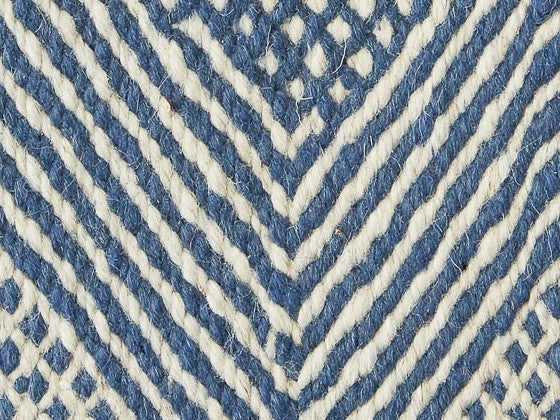
Kilims and flatweave rugs are among the best options for wall hanging. They are thin, relatively light and structurally stable, so they tend to work well in a vertical position. Because they have no deep pile, they also collect less dust and are easier to care for. Their geometric patterns often read beautifully on a wall.
The Moroccan kilims we know best include hanbels, the local name for traditional flatweave kilims; Zanafi, often characterised by stripes and supplementary threads that create a raised, three-dimensional effect; and Kharita textiles, graphic and highly versatile. Akhnif pieces, which are rarer and often more structured, can also work on a wall, but their weight and thickness should be assessed carefully.
Each type has its own graphic language: stripes, diamonds, central fields, sharp contrasts or more tactile surfaces. This is why flatweave rugs work so well above a sofa, over a headboard, along a hallway or in an entrance. They are among the most versatile wall rugs, and they usually do not require overly complex hanging solutions.
Discover Moroccan and Amazigh kilims
Figurative, vintage and collector rugs
These are the rugs that come closest to the idea of a textile painting. A rug with a narrative central field, a composition that reads like an image or a strong geometric subject can become a true textile artwork when displayed vertically.
Mid-twentieth-century Moroccan rugs from the High Atlas and Middle Atlas, including Beni Ourain, Beni Mrirt and Azilal pieces, often have abstract compositions of remarkable visual strength. On the wall, they can work as textile art in the full sense, especially when the design can be read frontally, the central field has presence or the rug carries a particular story.
The value of these pieces should not be treated as an investment promise. It may be preserved, or even grow over time, only if the rug is authentic, well kept and chosen with care. For this reason, the wall can be a sensible choice for rare, vintage or collector pieces: it protects them from daily wear while giving them visual importance.
Boucherouite and recycled rugs
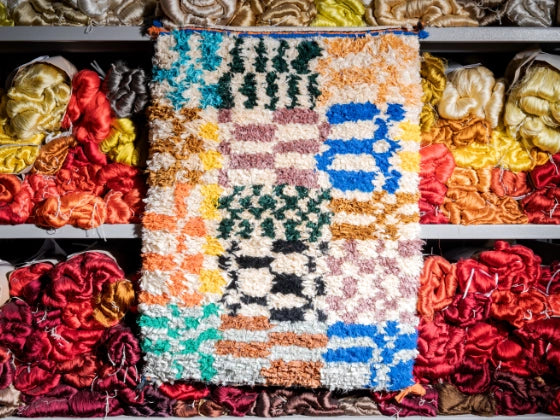
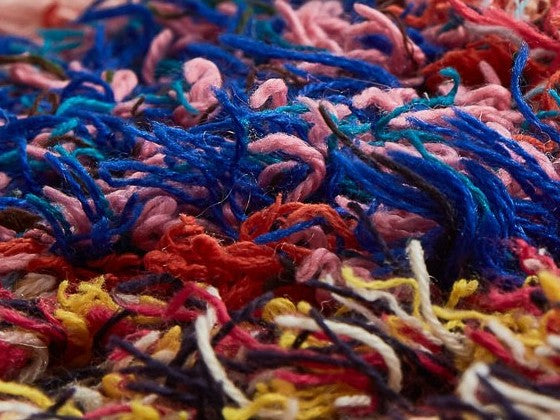
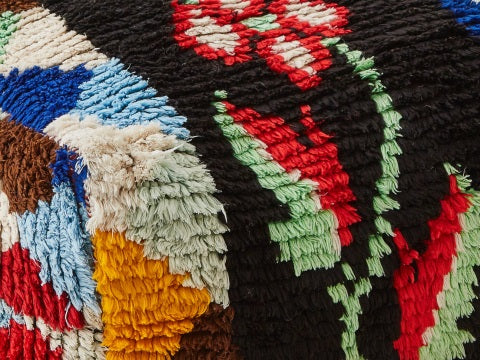
Boucherouite is one of the freest and most energetic Moroccan textile traditions. Made from reclaimed yarns, fabric scraps and fragments of old clothing, these rugs often have spontaneous, highly individual compositions. They bring colour, mixed texture, deliberate irregularity and a very physical presence.
On a wall, a Boucherouite works well in creative, eclectic or informal spaces: an entrance with personality, a gallery wall, a studio, a lived-in home, or even a small showroom or retail space. We have a small one displayed on the wall in our Milan showroom, precisely because its character reads so clearly in a vertical position.

Before hanging one, check its weight, thickness and edge regularity. Some pieces have structural irregularities that make installation more complex. This is not a flaw, but a typical feature of these rugs, and part of their charm.
Enter the colourful world of Boucherouite rugs
Mini tapestries and Zindekh
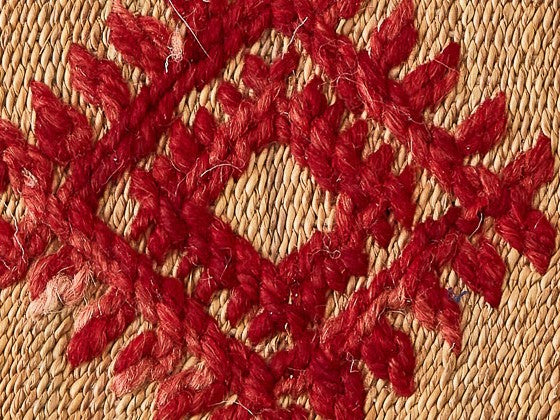
If you are looking for a small rug to hang without taking over an entire wall, or to give character to a corner, a Zindekh works beautifully as a mini tapestry. It can stand alone above a bedside table, be used in pairs on either side of a bed, form a triptych above a console, or become part of a larger composition with pictures and objects.

Small formats can also be framed, especially when the design has a strong graphic quality or when you want to protect the fibre from dust. In a gallery wall with paintings, photographs or ceramics, a small wall rug breaks the flatness of the composition and adds a material depth that a print cannot bring.
See the mini Zindekh tapestries
| Rug type | Where it works best | Pay attention to |
|---|---|---|
| Kilim / hanbel | Bed, sofa, console, hallway | Tension and hanging method |
| Figurative / vintage | Study, entrance, focal wall | Direct light and professional support |
| Boucherouite | Creative rooms, gallery walls, showrooms | Weight, thickness and irregular edges |
| Zindekh / mini textiles | Gallery walls, pairs, triptychs | Framing or dust protection |
| Long pile | Dramatic walls in low-dust areas | Maintenance, weight and dust accumulation |
Which rugs to consider with caution
Some rugs can be hung on the wall, but they require more care when choosing the wall, the hanging system and the maintenance routine. The main cases are these:
- Long-pile rugs: they can collect more dust deep in the pile, be heavier and visually distort over time if they are not supported evenly. It is not an absolute “no”, but the hanging system and maintenance need more thought.
- Very large or heavy rugs: if the weight is carried by only a few points, tension can damage the fibre, edge or backing over time. For important pieces, it is far better to work with an upholsterer, framer or textile restorer.
- Very delicate, antique or fragile rugs: avoid invasive methods, nails through the textile, aggressive clips or improvised systems. A valuable antique piece should be hung with the same care you would give to a work of art.
- Rugs exposed to direct light: sunlight can fade even resistant dyes over time, especially when exposure is long and always falls on the same area. Avoid walls that receive direct sunlight for many hours a day.
- Rugs close to humidity, heat, smoke or odours: a damp wall, fireplace, radiator, steamy kitchen or smoking area can damage the textile or make cleaning more difficult. Wool and highly textured fibres can absorb odours, soot and greasy vapours over time.
There are also situations where it is better to change wall or give up the idea altogether: a surface exposed to strong sunlight, a damp wall, a position too close to a fireplace or radiator, a very humid kitchen, or a rug that is too heavy to be hung safely. The same applies to an antique or fragile piece if you do not want to involve a professional. And one more very practical point: if the rug will be too high or awkward to reach, keeping it clean will become difficult.
Can hanging a rug damage it?
Yes, a rug can be damaged if it is hung incorrectly or placed in the wrong conditions. The main risk is not the fact of hanging it, but the way the weight is supported over time.
If the rug is fixed only at the corners, with too few hooks or with clamps concentrated in a few small areas, the weight can pull on the weave, deform the edges or weaken some fibres. Direct sunlight, wall humidity and heat from a radiator or fireplace can also accelerate fading and deterioration.
To reduce risk, choose a system that distributes the weight along the entire width of the rug: for example, a sewn pocket on the back with a support rod, or Velcro correctly sewn to the textile and fixed to a wooden slat. For very light textiles, coated clips or clamps may be considered, provided they are numerous, well distributed and do not crush the fibre.
The rule is simple: the larger, heavier, older or more precious the rug, the less you should improvise. In those cases, ask an upholsterer, framer or textile restorer for help, so the rug can look beautiful on the wall without unnecessary tension.
Where to hang a rug at home: room-by-room ideas
Below are some of the situations in which a wall rug can solve a problem or add something the room was missing. This is not just a list of possible places: each placement works when it responds to a real need in the space.
In the living room: a feature wall, not just a backdrop
A rug can become the feature wall of a living room when that area needs a strong focal point and you do not want, or cannot use, wallpaper or a large framed artwork.
The most effective positions are behind the sofa, especially when the sofa and walls are neutral; above a sideboard or long cabinet, where the rug completes the furniture below; or on a large wall, for example in a double-height living room or an open space.
Orientation matters. A horizontal rug usually works well above a sofa, sideboard or console. A vertical format can enhance a narrow wall, a corner near the fireplace or a portion of wall that would otherwise remain empty.
Leave breathing room around it: the rug should not look squeezed between the sofa and the ceiling. If the furniture below is simple, the textile can carry much of the room’s character on its own.
In the bedroom: the textile headboard
This is one of the most intuitive and effective placements. A rug hung above the bed, at least as wide as the bed frame or slightly wider, can replace or complement an upholstered headboard. Here, proportion is everything: the rug should not look too small for the bed, or too high above it.

Height also needs attention. It is usually best not to hang the rug too high: it should speak to the bed, like a textile headboard or an important artwork above the sleeping area.
Also think about pile. Dust is still a real issue, even on a bedroom wall. Flatweaves or short-pile rugs are easier to clean vertically. In a very minimal room, a subtle but textured rug can add warmth without making the space feel heavy.
In the entrance, hallway and passageways
Entrances, corridors and landings are spaces we cross every day, but often struggle to furnish because there is little room to work with. A wall rug can do more than expected here.
In an entrance, it can become the first sign of the home’s identity: the thing you see before you enter the main rooms. If the perspective allows the rug to be viewed frontally, the effect can be very strong.

In a hallway, especially if it is narrow, dark or has no room for furniture, a vertical rug can replace the usual sequence of pictures and give the wall depth without requiring any building work. The same applies to internal stairs and landings: spaces that are difficult to decorate, but often perfect for a well-proportioned textile intervention.
In the dining room: a backdrop for the convivial area
In the dining room, a rug can live in two places: under the table or on the wall, even if the second option is less common.

Behind an important table, or on a wall that would otherwise remain empty, a wall rug adds character and colour to a room often designed only around seating. It works well with a wooden table, a sculptural light and neutral walls. As mentioned above, avoid placing it too close to radiators or areas where a kitchen creates humidity or steam.
When chosen well, a wall rug in the dining room becomes the visual backdrop of the entire convivial area. It defines the character of the space even when nobody is sitting at the table.
In a study or reading nook
With an armchair, a lamp and a shelf of books, a wall rug creates a warm backdrop for a quiet corner. This is where vintage rugs, figurative pieces, Boucherouite and graphic kilims can work particularly well.
The rug should not look like an isolated object. It should speak to books, ceramics, objects collected over time, plants and lamps. The whole space should feel gathered, not simply decorated.
In a gallery wall or composition
A small rug placed within a mixed composition of paintings, photographs, ceramics, mirrors or wall objects breaks the flatness of the wall and adds texture among the framed works.
Proportion is important. A rug that is too large in a gallery wall will dominate everything, which can be beautiful if planned. A smaller piece, such as a Zindekh or a framed mini textile, can become the unexpected detail that catches the eye.
In pairs, triptychs or textile series
On long walls, behind bedside tables, above a sideboard or along a corridor, small wall rugs can be used as a series. Sometimes this works better than a single large rug, especially when you want a lighter, more dynamic effect.
Two mini rugs on either side of a bed, a triptych above a long sideboard, or a series of small geometric textiles along a hallway. They do not need to be identical: a shared palette, material or graphic rhythm is enough for the composition to hold together.
In showrooms, events and special spaces
We usually talk about private homes, but a rug used as a wall tapestry can also become a strong visual backdrop in commercial or professional spaces: boutiques, hotels, showrooms, representative offices, meeting rooms, fairs and photoshoots.

In these cases, the rug is not just decoration. It becomes part of the visual identity of the space. It can create atmosphere, express a point of view, define an exhibition corner or turn a neutral wall into something more intentional.
Because these are often public or high-traffic spaces, the hanging system must be even more secure and carefully designed. If the rug is used as a backdrop, divider or scenic element, weight, height, stability and maintenance should all be assessed with particular care.
How to choose a wall rug by interior style
Let’s start with something we care about: boho is not the only style where a wall rug makes sense. We say this because the word is used far too often as a universal label for anything with fringes and so-called “ethnic” geometry. A rug on the wall can work in many different interiors. Each style simply calls for a different kind of rug.

Eclectic or cultivated vintage home
Figurative rugs, vintage pieces with a story, rare finds and Boucherouite rugs with strong colours all work well in these interiors. The rug speaks to books, paintings, ceramics and objects collected over time. It does not need to look perfect. It can look found, chosen, inherited, brought home from a journey. Imperfection is part of the language. An eclectic wall with a vintage Moroccan rug often says more than wallpaper.
Boho, Mediterranean or creative home
Boucherouite, colourful kilims, free geometries and energetic graphic patterns all belong naturally here. The important thing is not to overdo it. If the rug is strong, the rest of the room should be lighter, so the piece has space to breathe. A colourful Boucherouite on a white wall, with just a few well-chosen elements around it, is often more effective than too many accessories competing for attention.
Minimalist, Japandi or natural home
Here, you do not need the loudest piece. You need the right one. A kilim in natural tones, a raw-fibre textile or a sober hanbel on a white wall should not feel like extra decoration, but like a softer surface. Warm, handmade, essential. For a home that is pared back but not cold, this can be the right language.
Contemporary, scenic or industrial loft home
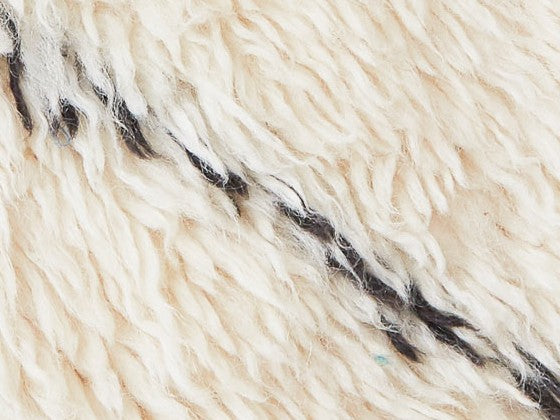
In very architectural spaces, scale matters. A small textile can disappear in a double-height living room. Beni Ourain rugs can work well, with their raw wool fields and graphic markings, as can Azilal and Beni Mrirt pieces, which often have more abstract and chromatically vivid compositions. A rug with a strong composition can replace a large contemporary artwork and bring something a flat piece cannot: fibre, warmth and physical presence.
How to hang a rug on the wall: the main methods
Now for the practical part: how do you hang a rug on the wall correctly, what should you avoid and when should you ask a professional?

The best way to hang a rug on the wall without damaging it depends on its weight, size, value, the type of wall and the visual effect you want. There is no single method that works for every rug. For antique, valuable, very heavy or fragile pieces, it is always better to consult an experienced upholsterer, textile restorer or framer. Enthusiastic DIY can ruin beautiful pieces.
For valuable rugs, one principle is essential: reversibility. The hanging system should be removable without causing permanent damage to the textile. A rod, a properly sewn pocket, Velcro on a wooden slat or a professional frame are preferable because they support the rug without piercing, gluing or altering it irreversibly.
Rod and sewn pocket on the back
This is one of the most common methods and, for many rugs, one of the best ways to distribute weight. A pocket in neutral fabric, such as raw cotton or linen, is sewn onto the back of the rug. A wooden, metal or brass rod is then passed through it and placed on wall supports or hooks.
The advantage is that the weight is spread across the full width of the rug, avoiding concentrated points of tension. The rod can be visible if it has a decorative role, or hidden. If the rug has value, the pocket should be sewn by someone experienced: avoid improvised stitching or staples directly on the fibre.
Velcro on a wooden slat
Velcro is often used in museum and gallery settings. One side of the Velcro is sewn to the back of the rug, never glued directly onto a valuable textile; the other is fixed to a wooden slat on the wall.
This system is discreet, reversible and allows the rug to be removed more easily for cleaning. The slat distributes the weight evenly and does not mark the textile. For valuable rugs, it should be done by skilled hands. The key point is this: the Velcro must be sewn, not glued.
Bar and clips or clamps
This is a simple, immediate solution, but mainly suitable for light textiles, pieces of limited value or temporary decorative installations.
The clips must distribute weight evenly. Avoid systems where just a few points carry the whole load. If the clips mark the fibre, crush the pile or concentrate tension in a few centimetres, they are not the right method for that rug.
Framing a rug or mini tapestry
A framed rug is ideal for small formats, textile fragments, mini Zindekh and rare pieces. A box frame, or a support with plexiglass or museum glass, protects the fibre from dust and turns the piece into textile wall art in the most literal sense.
For valuable pieces, choose a framer used to working with textiles. A handmade rug should not be compressed, stretched or treated like a print on paper.
Mounting on a panel or rigid support
For small rugs, fragments or collector pieces, a rigid panel can distribute weight evenly and keep the textile flat. It can be useful for pieces that tend to curl or have an irregular structure. Again, invasive DIY is not a good idea on precious textiles.
Methods to avoid
- Nails directly through the textile: tears are often irreversible. A concentrated point of tension on a single thread can compromise the rug’s structure.
- Upholstery staples on the rug: these can mark or weaken the fibre, and metal can oxidise over time. Consider them only for pieces with no real value, and only as a very temporary solution.
- Double-sided tape or glue on the back: the back of a hand-knotted rug is woven in wool or cotton. Glue residue is very difficult to remove without damage.
- Too few hooks for a heavy rug: a large, heavy rug cannot be carried by two anchor points. The weight needs to be distributed along the full width, otherwise both textile and wall may suffer.
- Ignoring the type of wall: plasterboard, brick, plaster and concrete require different anchors and support systems. A fixing chosen without assessing the wall may loosen over time or fail to hold the weight.
Whatever system you choose, check it periodically. Velcro, rods and clips can loosen over time, especially with the weight of the rug and seasonal changes in temperature or humidity.
Before hanging it: checks to make
Before fixing a rug to the wall, it is worth checking a few practical details. They are simple, but they make the difference between a beautiful, safe installation and an improvised one.
Here is the checklist to keep in mind.
Weight and dimensions
The larger the rug, the more important it is to distribute the weight correctly. A large wool rug can weigh several kilos, sometimes more than 10 kg if it is dense, thick or tightly knotted. It should not be hung from two points only. It needs a system that spreads the load across the full width.
Check the wall, use anchors suitable for the support and do not improvise, especially if the rug is large, heavy or valuable.
The direction of the pile
The direction of the pile is important and often overlooked. In pile rugs, the pile has a natural direction and should fall downwards when the rug is hung.
To check it, run your hand from top to bottom: you should not feel resistance. Hanging the rug with the pile in the right direction helps the rug read as it should, and can also reduce dust accumulation in the fibres over time.
Sun, humidity and heat sources
Check the light before choosing the wall. Direct sunlight can damage dyes over time, especially natural dyes and delicate colours.
Also consider humidity, condensation and heat sources. A damp wall, fireplace, radiator or kitchen with a lot of steam can damage the fibres over time. Choose a dry, stable wall away from direct heat.
Cleaning before installation
Gently vacuum the rug before hanging it, using low power and a textile nozzle. Check both the pile side and the back, especially if the rug is vintage or structurally irregular.
Also check fringes, edges, seams and any loose threads that may need securing. A wall-hung rug is protected from foot traffic, but not from dust settling on vertical fibres. Starting with a clean rug makes maintenance easier.
How to care for a wall-hung rug
The idea that a rug on the wall does not get dirty is tempting, but not quite true. It gets less dirty than a rug on the floor, of course: no shoes, no daily foot traffic, no debris brought in from outside. But dust still settles, especially on pile rugs and raised textures.
Maintenance is simple: vacuum gently, with a textile nozzle or low suction, always from top to bottom. Do not rub the surface and do not beat the rug while it is hanging.
If the rug is near a window or receives a lot of light, check from time to time that the colour is not fading unevenly. Cleaning frequency depends on the room, airborne dust, pets, allergy concerns and proximity to windows, kitchens or high-traffic areas.
No stress: light, regular care is enough, as long as you do it before dust builds up too much.
For valuable rugs, occasional professional cleaning is the safest choice.
Common mistakes
Mistakes when hanging a rug on the wall rarely come from carelessness. More often, they come from enthusiasm, haste or advice found online without enough context.
- Hanging a heavy rug from too few anchor points. A large rug cannot be supported by two or three hooks, however solid they may seem. The weight must be distributed along the full width, and the anchor must suit the wall: plasterboard, brick, plaster and concrete require different systems.
- Using nails, glue or staples directly on a valuable rug. On a handmade, antique or precious piece, any invasive fixing can cause damage that is difficult to repair. This also applies to vintage rugs: age can make fibres more fragile, and older dyes react differently to tension and humidity.
- Choosing a long-pile rug for a wall that is hard to reach. Long pile can look beautiful on a wall, but it collects dust more deeply and needs regular care. If the rug is above a large sideboard or behind a bed, think about how easily you will be able to vacuum it.
- Exposing the rug to direct sunlight. This is not an immediate problem, but it is often irreversible. Once the colour has faded unevenly, there is little that can be done.
- Not checking the pile direction before hanging it. If a rug looks different on the wall, this may be why. Run your hand over the pile and make sure it falls naturally downwards.
- Getting the height wrong in relation to the furniture below. Above a bed, sofa or console, the rug should relate to what is beneath it. It should not float too high or overpower the furniture. Proportion matters as much as the piece itself.
- Hanging a rug without considering the context. A piece can be beautiful on its own and feel disconnected once on the wall. Colour, scale, style and viewing point should be considered together before drilling.
- Forgetting how it will be removed for cleaning. A system that does not allow the rug to be taken down relatively easily can become a problem. It is better to think about this beforehand, especially if the rug is large or difficult to reach.
Our final tips
Every rug hung on the wall says something. The right choice depends on the effect you want, the space available, the type of wall and how much maintenance you are willing to give it. A wall-hung rug works when the piece, the proportion and the hanging system are considered together.
If you want a graphic, ordered effect: kilim, hanbel, Zanafi, Kharita. Geometric patterns that read well on the wall, stable structures and simple maintenance.
If you want an artistic, narrative effect: figurative, abstract, rare or vintage rugs. Pieces whose story can be felt with the eye and, almost, with the hand.
If you want colour, energy and freedom: Boucherouite. No strict rules, no symmetry to respect at all costs. Just vitality, material and rhythm.
If you have limited space: mini tapestries, Zindekh, small framed rugs or pairs. Even a 50 × 80 cm piece can have presence, if it is in the right place.
If the rug is very precious or heavy: pause before drilling. Weight, proportion, viewing point and hanging method all need to be considered.
A light kilim, a rare figurative rug, a colourful Boucherouite or a small Zindekh can completely change the way a room feels, provided it finds the right place. And sometimes, when you look closely at a rug, you immediately understand that its place is not the floor.
Useful guides if you are also choosing a rug for the floor:
How to choose a rug for the living room
How to choose a rug for the bedroom
Runners and rugs for entrances and hallways
How to choose a rug under the dining table
FAQ - Frequently asked questions
What is a rug hung on the wall called?
In English, it may be called a wall rug, rug wall hanging, decorative wall rug or textile wall art. The word tapestry is more precise for textile pieces made to be hung, but it is also commonly used for rugs and textiles displayed vertically.
What is the difference between a wall rug and a tapestry?
A tapestry is designed to be hung: its technique and composition are meant for frontal viewing. A rug is made for the floor, but when hung on the wall it can take on a similar decorative role. The difference lies in the original purpose, not always in the final effect.
What kind of rugs can be hung on the wall?
Kilim, hanbel and flatweave rugs are among the most suitable because they are lighter, more stable and easier to manage. Figurative, vintage and Boucherouite rugs, mini tapestries and Zindekh can also work well. Long-pile, very heavy or antique rugs need more care: as size and weight increase, the hanging system becomes more important.
How do you hang a rug on the wall without damaging it?
The safest methods are usually a rod with a pocket sewn on the back, or Velcro sewn to the textile and fixed to a wooden slat. Both distribute the weight across the full width of the rug. Avoid nails through the fabric, glue, staples and too few anchor points, especially on heavy, antique or valuable rugs.
Can you hang a rug without drilling holes?
Only in very limited cases, with very light textiles of no particular value and systems suitable for both the weight and the wall. Adhesive strips are not advisable for heavy, handmade or precious rugs. Freestanding display structures, bars or modular systems may be better alternatives when you want to avoid drilling.
Is Velcro, a rod or hooks better?
It depends on the rug. A rod with a sewn pocket is versatile for medium and large rugs. Velcro on a wooden slat is practical when the rug needs to be removed for cleaning. Hooks, clips and clamps are more suitable for light textiles or temporary installations. For valuable pieces, a rod or Velcro system handled by an expert is usually preferable.
How do you hang a heavy rug?
A heavy rug needs a system that distributes weight along its full width, such as a rod with a sewn pocket or Velcro on a long wooden slat. You also need anchors suitable for the wall. Do not rely on just a few hooks: they concentrate the weight in small areas and can damage both rug and wall.
Can a rug be framed?
Yes. Framing is a good option for small rugs, mini tapestries, textile fragments and rare pieces. Box frames, plexiglass or museum glass can protect the rug from dust, provided the fibres are not compressed. For valuable pieces, choose a framer used to working with textiles.
Does a rug on the wall collect dust?
Yes, although usually less than a floor rug. Routine care means gentle vacuuming with a textile nozzle, low suction and movements from top to bottom. Frequency depends on the room, dust levels, pets, allergies and proximity to windows or the kitchen.
Where is the best place to hang a wall rug at home?
The best place is where the rug answers a real need: above the bed as a textile headboard, behind the sofa as a feature wall, in the entrance as a first sign of the home’s identity, in a study as a warm backdrop or in a hallway to give depth to an empty wall. There is no single correct placement: the room, the rug and the viewing point must work together.