


Rugs and underfloor heating: yes, it can work. With a bit of care.
Can you put a rug on underfloor heating? Or will it block the heat and make the system work twice as hard? It is a fair concern, but it is often based on a mistaken assumption.
What really matters is not WHETHER you use a rug, but choosing one that does not obstruct heat, damage the floor, or leave you regretting the choice a few months down the line.
This is not just a reassuring answer: it is a real technical distinction, and it makes all the difference between a rug that works well with the system and one that gets in the way.
In this guide, we look at the issue without unnecessary alarmism. We will focus on what really matters — materials, thickness, backing, underlay and placement — and we will also clear up a few common myths, because online you will find extreme opinions in both directions, and neither of them really helps you choose well.
The short answer
Yes, you can use a rug with underfloor heating. Three things make the biggest difference: backing, overall thickness and materials.
That is the short version. Below, you will find the reasoning behind it, along with the cases that need a little more attention.
What you will find in this guide
To avoid getting lost in the details, it makes sense to start with three simple rules.
3 practical rules
A rug is not automatically the enemy of underfloor heating. It only becomes a problem when it has specific characteristics that obstruct the passage of heat. These three practical rules clear up most of the common doubts.
The first thing to check is very simple.
Rule 1: make sure the backing is not rubber, latex-based or glued on

The backing is the first thing to look at. A rubber, latex or foam backing traps heat underneath instead of allowing it to rise through the rug.
But the issue goes beyond thermal efficiency. With the steady heat of an underfloor system, latex tends to break down over time. It softens, sticks to the floor and can leave behind residues that are very difficult to remove. On parquet wood or laminate flooring, the damage may be permanent. This is a known issue, and not an uncommon one.
The rugs to avoid are generally those with:
- latex backing (white or black, common in industrial tufted rugs)
- solid rubber or compact foam backing
- glued backing, even if it is made from a material other than latex
A better option is: a wool, cotton or other natural fabric backing. Handmade rugs made from natural materials usually do not have any synthetic backing at all.
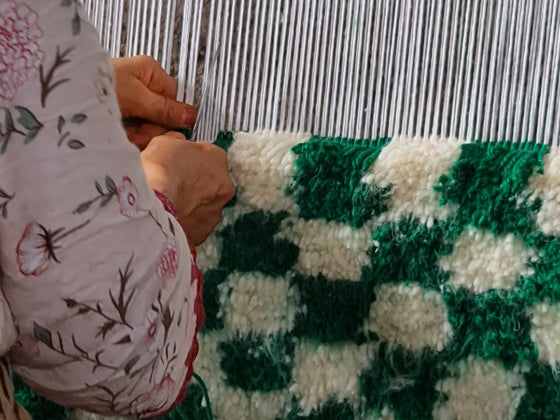
Authentic Moroccan handmade rugs do not have rubber or latex backing. Their structure is woven, with warp and weft in naturally breathable wool. That is one of the reasons they work well with heated floors.
But backing alone is not enough.
Rule 2: pay attention to the overall thickness (rug + underlay) to avoid too much insulation

The second factor is thickness. Every extra layer between the floor and the room adds resistance to heat transfer. In other words, the more layers you add, the harder it is for heat to pass through easily.
As a practical rule of thumb, 1.5 cm of overall thickness — rug plus any underlay — is often used as a reference point. Beyond that, thermal resistance may start to have a more noticeable effect on efficiency.
The most common mistake is to think only about the rug itself and forget the underlay. A 1 cm rug with an 8 mm underlay already brings the total to 1.8 cm. It is the combined thickness that matters.
As a practical guideline, very thick rugs or rugs with substantial padding deserve a little more attention, especially if you are also adding an anti-slip underlay. Thinner rugs and flat weaves let heat pass through more easily.
The cases that usually require the most care are:
- Shaggy or long-pile rugs, especially synthetic ones: a very deep pile creates a more insulating layer and can reduce the system’s output.
- Rugs with internal padding: some modern designs have a thicker or foamed structure, which makes heat transfer less efficient.
- A thick rug combined with a thick underlay: even a rug that seems manageable on its own may become less suitable once paired with an overly insulating underlay.
In general, kilims, hanbel, and short- or medium-pile wool rugs are easier to manage on radiant heating, provided the backing is breathable and non-synthetic.
A technical note, just for completeness
Some technical guides on underfloor heating refer to thermal resistance, often expressed in English-speaking markets as a tog value. In simple terms, it is a way of measuring how much a material resists the passage of heat: the higher the value, the greater the insulating effect.
Across European technical sources, the most common rule of thumb is this: the rug on its own is ideally kept below 1.5 tog, while the combined rug + underlay system should generally stay below 2.5 tog. This is a fairly consistent guideline among manufacturers, installers and specialist retailers.
We mention it here for completeness and transparency. In practice, however, this information rarely appears in rug product descriptions and almost never in the artisanal world. That is why, in real buying decisions, it is usually more useful to focus on much more concrete factors: backing, overall thickness, rug construction and any underlay.
So far, we have looked at structure. Now let us move on to materials.
Rule 3: choose breathable fibres and breathable construction, ideally handmade
The third factor is the rug’s material and the way it is woven. Not all materials respond to heat in the same way: some allow it to pass through easily, while others tend to retain it or cope less well with steady temperatures over time.
Wool, cotton and natural plant fibres generally work well with underfloor heating: they allow heat to pass through efficiently and do not deteriorate at the temperatures typically reached by heated floors (with a maximum surface temperature of 29°C under UNI EN 1264). Viscose and lower-quality synthetics, by contrast, can be more vulnerable to repeated temperature changes in the long run.
For this reason, handmade rugs in natural fibres — especially hand-knotted or hand-woven pieces without synthetic backing — are often the most balanced and reliable choice.
How underfloor heating works — and what happens when you add a rug
A radiant underfloor heating system warms a room from the ground up, using water pipes or electric heating elements embedded beneath the floor surface.
The water in the system usually circulates at temperatures between 30°C and 40°C, and the floor itself becomes the heat source. As a comfort guideline, the floor surface should not exceed 29°C, according to UNI EN 1264.
Compared with traditional radiators, a radiant system is more energy-efficient, but also more sensitive to anything that sits on top of the floor. Any additional layer — low furniture resting directly on the floor, rugs, underlays — affects how much heat reaches the room.
Put like that, it may sound more complicated than it really is.
What happens with a rug? It can slow heat transfer — but only if it is too insulating
A rug does not block heat altogether. It slows it down to varying degrees, depending on its thickness, material and backing. And that difference is not trivial.
➜ A rug with the right characteristics — thin, made from natural fibres, with a breathable backing — has only a limited effect on efficiency, and the system can usually compensate without major issues.
➜ A rug with the wrong characteristics — thick, compact, or backed with insulating materials — makes the system work harder, which can lead to higher energy use over time.
So the real question is not whether you should use a rug at all. It is understanding which kind of rug works well, and which kind may be a poor fit.
When it becomes a problem: too much coverage + insulating layers
When rugs do create real issues for underfloor heating, it is almost always because of a combination of factors: a thick rug, an insulating underlay, and a very large covered surface.
In large open-plan spaces, or in rooms where the temptation is to cover almost the entire floor with one oversized rug, the effect becomes more noticeable. The system ends up facing a barrier across most of the surface, and its performance may be reduced more significantly.
The underlay is often the silent culprit: it adds thickness, may have an insulating backing, and is often chosen without much thought. It deserves the same level of attention as the rug itself.
Common myths about rugs and underfloor heating
There are still plenty of oversimplifications around rugs and underfloor heating: some make the issue sound much worse than it really is, while others lead to conclusions that are not especially helpful when it comes to choosing well.
So it is worth clearing up three very common misconceptions.
“Wool is too insulating.” Spoiler: it depends on thickness and layering
Wool does have insulating properties, and that is exactly where one of the most common myths begins: the idea that a wool rug will always block heat.
In reality, a material’s thermal conductivity on its own is not enough to explain how a rug behaves on heated floors. Thickness, weave density, overall construction, and whether or not there is an insulating backing all matter. A thin, flat-weave wool rug allows heat to pass through in a way that is perfectly compatible with the system; a shaggy rug with a 5–6 cm pile and perhaps an underlay is a very different matter.
Wool in itself is not the problem. Thickness and layering are.
There is, however, another even more widespread misconception — one that starts from a perfectly understandable concern.
“Rugs are forbidden with underfloor heating.” Not quite.
This is the position taken by some technical sources — installers and heating-system manufacturers — who, out of caution, tend to advise against rugs altogether.
It is not exactly wrong, but it is a simplification driven mainly by caution. The problem is that, put this way, it lumps together rugs that are actually very different from one another.
The advice to “avoid rugs” often comes from experience with industrial models that are tufted and backed with latex or other less breathable materials. Those do require a great deal of care. But not all rugs are made that way. As we have seen, there are rugs with natural backing, breathable construction and balanced thickness that can coexist perfectly well with radiant heating systems.
“An anti-slip rug is not suitable for underfloor heating.” It depends on how it is made.
This is perhaps the most misleading myth of all, because it starts from a legitimate need — safety — and ends in an overly simplistic conclusion.
“Anti-slip” is not a category in itself: it is simply a property that can be achieved in several different ways, some of which are better avoided. A rug with a compact rubber backing may well be anti-slip, but it is also highly insulating and can create more problems on a heated floor.
A natural felt or perforated mesh underlay, on the other hand, helps keep the rug stable without significantly interfering with heat transfer. The point is not to avoid everything anti-slip, but to distinguish between breathable solutions and overly compact backings.
Which rugs to choose: materials, pros and cons
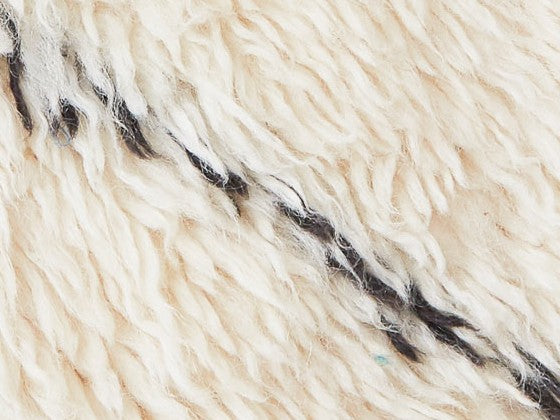
Short- or long-pile wool rugs (knotted or woven): comfort and breathability
Wool is one of the most balanced materials for underfloor heating because it combines several qualities that make it well suited to this kind of use.

- It holds up well under the steady temperatures of underfloor heating.
- It does not deteriorate with heat.
- The natural structure of the fibres does not encourage condensation or moisture build-up.
- Natural lanolin helps the fibre retain its elasticity and softness, even with the repeated heating cycles of the colder months.
A short-pile or flat-weave wool rug is one of the most sensible choices for heated floors.
To learn more, you can also read: Wool rugs: everything you need to know
Kilims and flat weaves: thin, practical, and ideal for heated floors
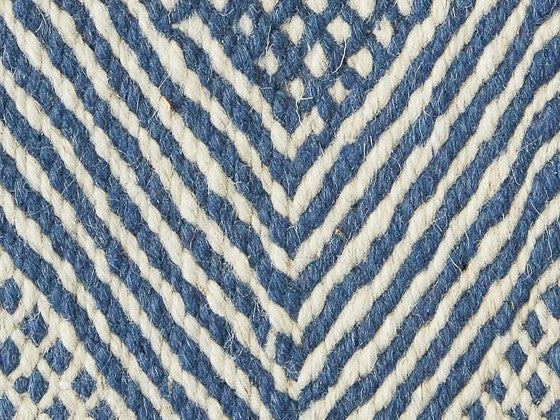
Kilims (known in Morocco as hanbel) are flat-weave rugs with no pile. They are among the best options for underfloor heating: minimal thickness, a fully breathable structure, and no synthetic backing.

Heat passes through easily, maintenance is simple (they are quick to vacuum and do not trap dust deep in the structure), and the look is clean and contemporary.
On heated floors, a Berber kilim or a Moroccan hanbel is about as low-impact as it gets. If a rug tends to slip, a thin layer of natural felt is enough to keep it in place without adding insulation.
Plant fibres and mats
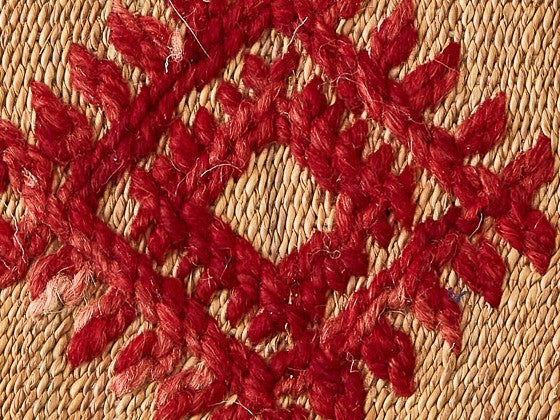
Jute, straw and palm fibre are all natural materials with good thermal conductivity. Straw mats and thin plant-fibre pieces allow heat to pass through efficiently.

That said, jute does require a little more caution: it is highly hygroscopic (it retains moisture) and tends to have lower conductivity than other plant fibres (source: Wikipedia). On a floor that goes through repeated temperature changes, it may become less stable over time, especially if the system is also used for summer cooling. Industrial jute mats also tend to have a latex backing to keep them in place. On heated floors, that is best avoided.
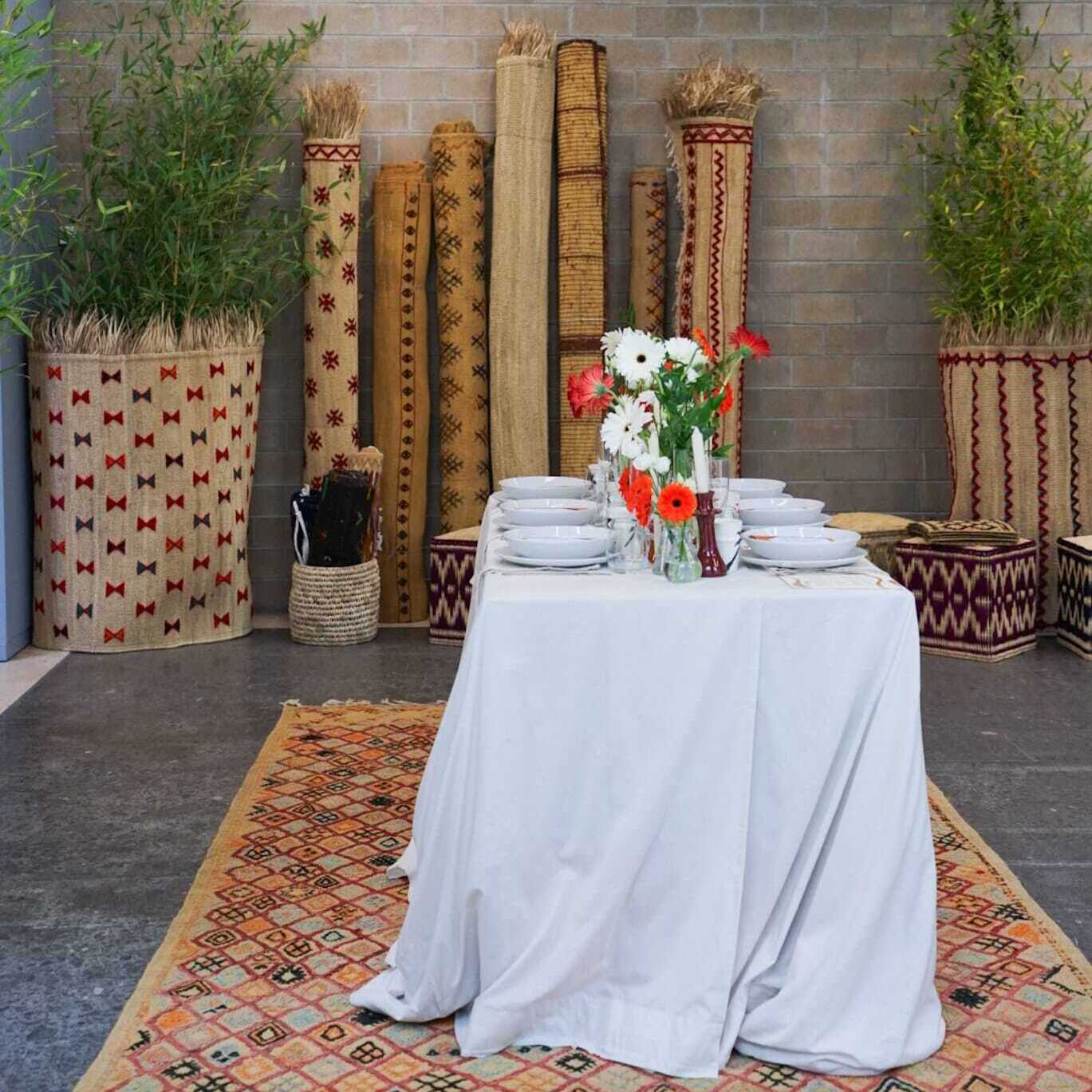
Hassira mats in palm straw and Saharan rugs in palm wood are a higher-quality alternative. They were developed to solve a very practical problem: the extreme temperature swings of desert and mountain landscapes in North-West Africa. In nomadic tents, they served as both flooring and insulation, then could be rolled up and loaded onto dromedaries. In other words, they were designed to be lightweight, resilient and thermally effective in demanding conditions.
It is hard to imagine a more fitting heritage for a rug that is going to live on top of an underfloor heating system.
To discover the history of these pieces, you can read: The last Saharan mats
Sabra / viscose: silk-like effect, but more delicate (depending on construction)
Sabra (or “cactus silk”, even though it has not actually been made from cactus for decades) and viscose have a beautiful luminous, silky finish. On heated floors, however, they are among the fibres that require the most caution.
Viscose is a cellulosic fibre that does not cope especially well with humidity and repeated temperature changes. Over time, the heat cycles of underfloor heating can speed up its deterioration, with possible yellowing, fibre stiffening and loss of lustre. It is not an immediate problem, but it tends to show over time.
If you love the look of sabra and want to use it on heated floors, choose thinner constructions, check the backing carefully, and reserve it for low-traffic areas where heating is not constant all year round.
Rag rugs and Boucherouite: yes, as long as they stay breathable
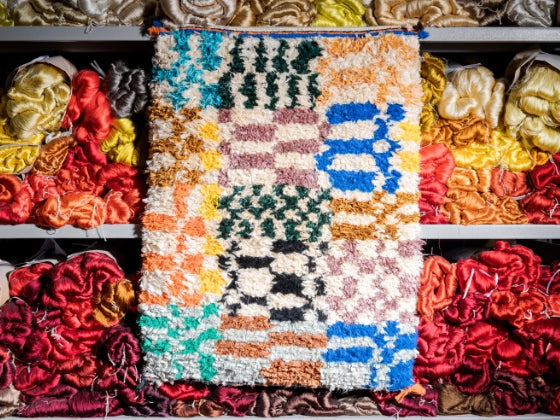
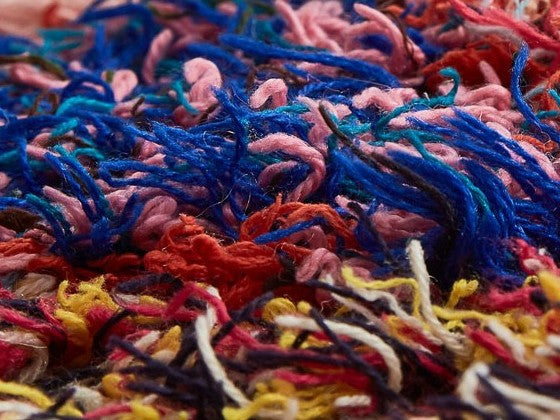
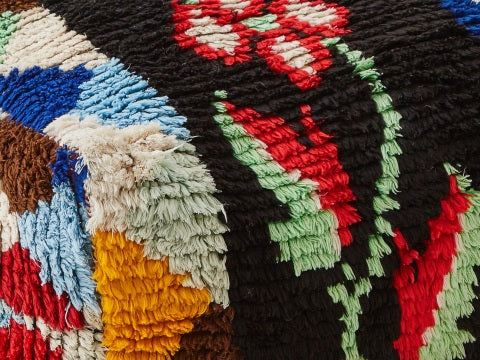
Rag rugs, known in Morocco as Boucherouite, are made from mixed recycled textiles. They may include scraps and strips of cotton, wool, nylon, tulle, denim and other reused materials. Their structure varies a great deal: some are thin and light, others thicker and more layered.
Here too, compatibility with underfloor heating should be assessed using the same criteria already outlined in the 3 practical rules at the start of this guide.

Zindekh rugs are a special case: a striking example of upcycling, they are made by reusing small plastic food sacks as a base and covering them by manually inserting strips of fabric with a punch-needle technique.
From the point of view of underfloor heating, the key technical detail is that plastic base, which is less breathable than a natural fibre. In practice, though, this is not a major issue: Zindekh pieces are small mats, around 95 x 50 cm, and the surface area they cover is simply too limited to have a meaningful effect on heat distribution. In small sizes and without an underlay, they work well.
A useful check before buying: the case of tufted rugs
You do not need to become an expert in textile techniques to choose well. But there is one case worth recognising before you buy, because it is among the most likely to hide a less breathable backing: tufted rugs.
Not all of them need to be ruled out, but many industrial versions have latex, glue or synthetic materials on the back, and those are best treated with caution. That is why being able to spot them at a glance can be genuinely useful.
How to recognise a tufted rug in 30 seconds
Because labels do not always make it clear, here are the signs to look for:
- Uniform, smooth backing: in tufted rugs, the back is often covered with a continuous layer of latex or glue, so the woven structure is not visible.
- Rubbery feel: if you press the back with a finger and it feels soft, yielding or slightly tacky, it is likely to contain latex.
- A separate bottom layer: in tufted rugs, the layer that forms the backing can often be lifted slightly, because it is glued on rather than woven into the pile.
- The word “tufted” or “taftato” in the product details: if that appears without any clear explanation of the backing, it is worth being cautious.
- An unreadable weave: in hand-knotted or hand-woven rugs, turning the piece over clearly reveals the pattern created by knots or weave. In tufted rugs, the back tends to look opaque and uniform.
In short: if the back is not clearly visible, or if the composition is unclear, treat it with caution and ask before buying.
Size and placement: how to use rugs without compromising heat flow
The size and position of a rug are another factor to consider alongside the material. Manufacturers do not usually give universal percentages, but the principle is simple: the more free floor surface you leave, the better the system can perform.
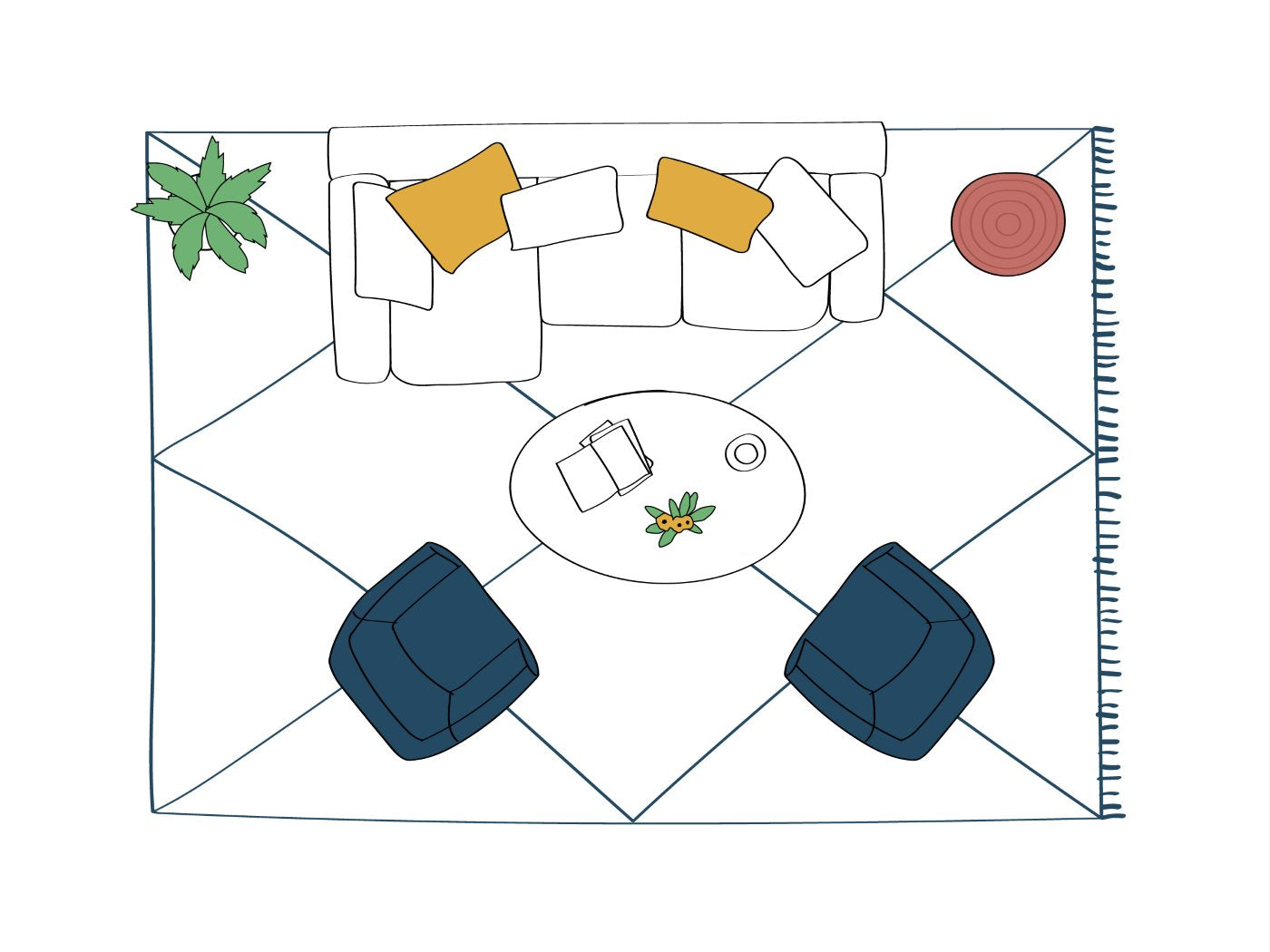
Especially in larger spaces, the most balanced solution is to use separate rugs as islands: one to define the seating area, one for the dining area, perhaps another in the entrance. Each rug covers a specific functional zone, while the heated floor still has enough exposed surface to radiate properly.
Another useful precaution is to avoid trapping rugs under low, very heavy furniture, such as sideboards, storage beds that sit close to the floor, or wardrobes. In those situations, covered area and static load combine, which can reduce local efficiency and increase the risk of localised heat build-up.
At this point, it makes sense to think room by room.
Where it works best — and where a little more care is needed
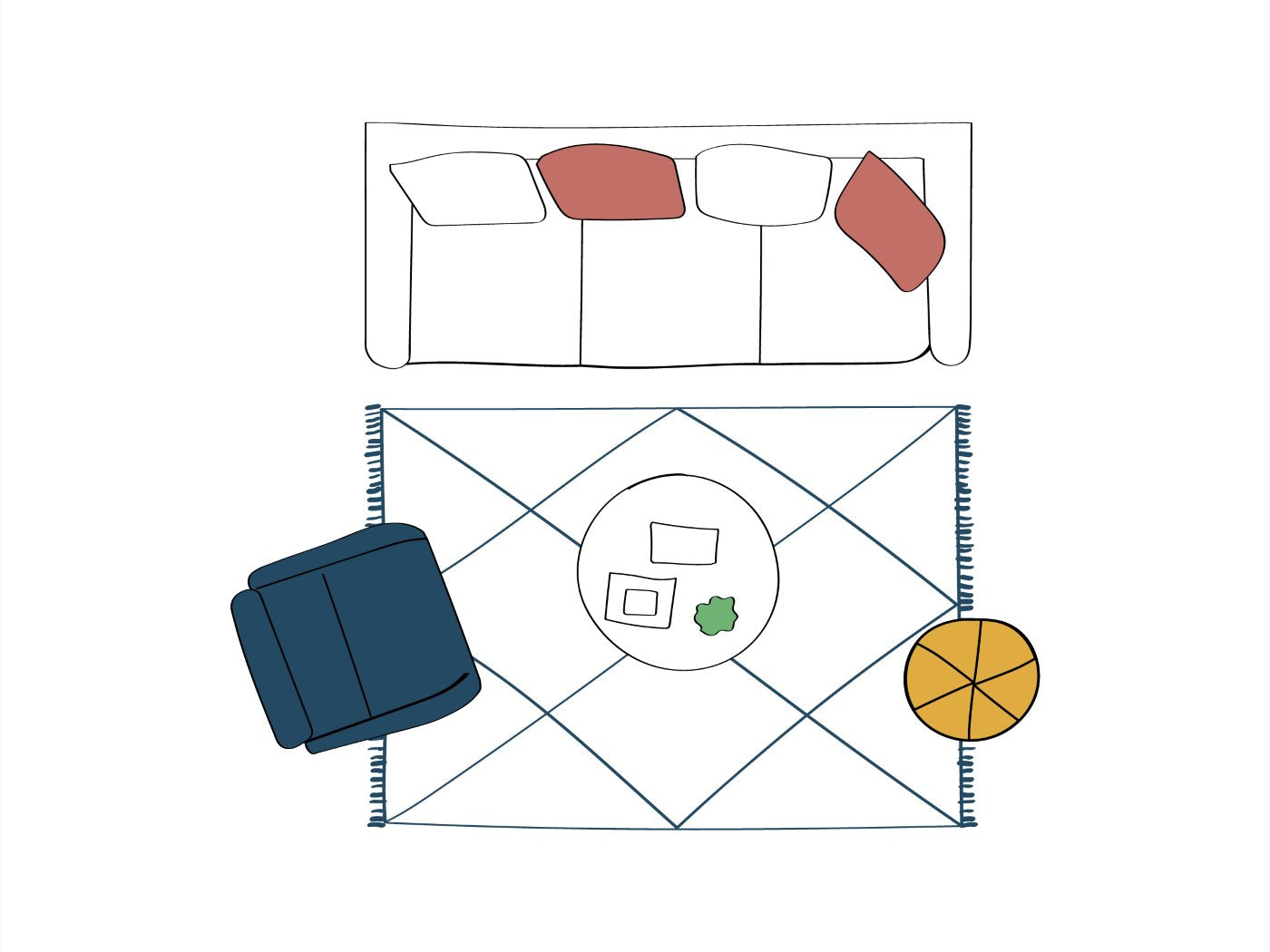
Living room: the most common setting, and generally the easiest, as long as the rug is proportionate to the seating area.

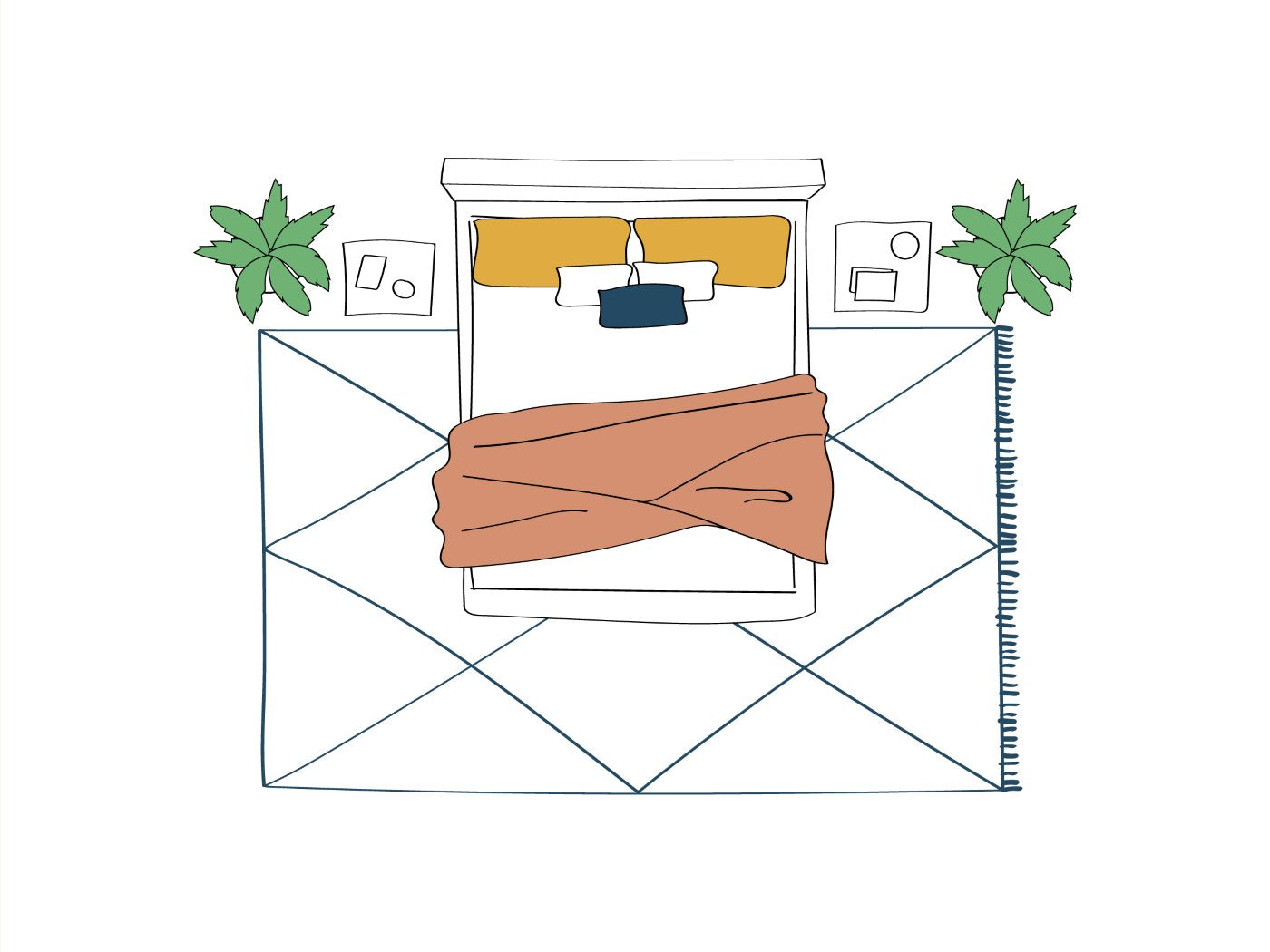
Bedroom: rugs are often placed at the sides of the bed or partly underneath it. Here too, proportionate dimensions and natural fibres usually work without problems.

Bathroom: this is the most delicate area. Underfloor heating is now common in bathrooms, especially in new builds, and bath mats are among the items most likely to have rubber or latex backing. Always check the backing before placing any mat in a bathroom with heated floors.

For more placement tips, here is our guide: How to place rugs at home (room by room)
Focus: underfloor heating with parquet wood and laminate flooring
Wood and laminate over underfloor heating are becoming increasingly common, but they do require a little more care than stoneware or ceramic floors. Here, the issue is not so much the rug itself, but the flooring underneath, which is more sensitive to heat and temperature changes.
A little extra care when choosing a rug
Wood or laminate floors can absolutely be used with a radiant heating system, but the combination needs to be managed with respect for installation guidelines and the materials chosen. Wood naturally reacts to changes in temperature and humidity, so it is only normal that it calls for a little more attention than other surfaces.
In this context, a very thick rug or one with a non-breathable backing can create a more insulated patch where heat disperses less easily. Ceramic and porcelain tiles, for example, tend to tolerate localised temperature variations better, while wood remains more sensitive to concentrated thermal changes. That does not mean rugs should be avoided altogether, but it does mean that lighter constructions, flat weaves, breathable backings and rugs that do not cover overly large areas are usually the safest choice.
The most useful precautions for heated wood and laminate floors are:
- choose low-pile or flat-weave rugs
- make sure the backing is not rubber or latex
- avoid covering very large areas with a single rug
- choose natural felt as an underlay, rather than rubber
- rotate the rug regularly
Underfloor cooling: what to keep in mind in summer
Many modern systems are also used in summer, in cooling mode: the floor becomes a cooling surface, and when rugs are involved, humidity becomes part of the picture too.
With cooling, the floor surface drops below room temperature. In less breathable areas — for example under tightly woven rugs or rugs with impermeable backing — air moisture may condense on the cooler surface, which can create less favourable conditions over time.
This is not a reason to give up rugs altogether, but it is a reason to pay a little more attention to their structure, materials and size.
Other useful precautions are:
- during the first seasons of use, consider lifting the rug during the hottest or most humid hours
- if you notice moisture under the rug, move it and allow the floor to dry fully before putting it back
The same choices that help in winter — natural fibres, breathable backing and proportions that make sense for the space — also work well in summer.
At this point, it helps to pull everything together in a few practical points.
Final checklist (save it): 8 common-sense checks before choosing a rug for a radiant floor heating
- It is best to avoid rubber or latex backing → backing in wool, cotton or other natural fibres is generally more suitable; rubber, latex and dense foams require more caution
- Be careful with tufted rugs that have glued backing → always check how the back is made before buying
- Pay attention to overall thickness → thin rugs and flat weaves are usually easier to manage; thicker rugs need a little more care, especially if there is also an underlay
- Choose the underlay carefully → thin natural felt or perforated mesh are usually safer choices; solid rubber, latex and memory foam are generally less suitable
- Prefer natural fibres and breathable construction → wool, cotton and some plant fibres are usually the most balanced options
- Choose proportions that suit the room → avoid rugs that cover almost the entire floor, so that enough heated surface remains exposed
- Keep up with regular maintenance → a clean rug also helps maintain better overall comfort and performance
- If you also use summer cooling → pay a little more attention to humidity, airflow and the rug’s breathability
If you still have questions, you will probably find the answer below. Otherwise, you can write to us directly.
FAQ
Can I put a rug on underfloor heating?
Yes. Rugs are not automatically a problem on heated floors; problems arise only when the rug has the wrong characteristics — latex or rubber backing, excessive thickness, or insulating materials. With a thin rug made from natural fibres and a breathable backing, using it with underfloor heating is entirely possible.
Do rugs really block heat?
Not exactly. They do not block heat completely — they slow it down. A rug with the right characteristics has only a limited impact on efficiency, and the system can usually compensate easily. A very thick rug with an insulating backing, however, can increase energy use more noticeably because the system has to work harder to compensate for the extra layer.
Which material is best: wool, cotton or synthetic?
For underfloor heating, wool and cotton are generally the most balanced choices. They allow heat to pass through without deteriorating under the steady temperatures of the system. Synthetics depend heavily on construction — the main issue is usually the backing rather than the fibre itself. Viscose tends to be the most delicate, because it reacts poorly to repeated temperature changes over time.
Why are rugs with rubber or latex backing not recommended?
For two main reasons: they are more insulating, which can reduce system efficiency, and they also tend to deteriorate under constant heat. Latex can soften, stick to the floor and leave residues that are very difficult to remove. On wood or laminate, the damage may be permanent.
Is an anti-slip underlay necessary with underfloor heating?
It can be useful for safety and stability, but it needs to be chosen carefully. Thin natural felt or perforated mesh are generally suitable options. Solid rubber, latex and memory foam are less suitable. The underlay should not add unnecessary insulation, and its thickness must always be considered as part of the overall system.
What thickness is best for a rug on heated floors?
As a practical guideline, very thick rugs or rugs combined with substantial underlays need more care. Kilims, hanbel and short- or medium-pile rugs are generally easier to manage on underfloor heating.
Should shaggy rugs be avoided?
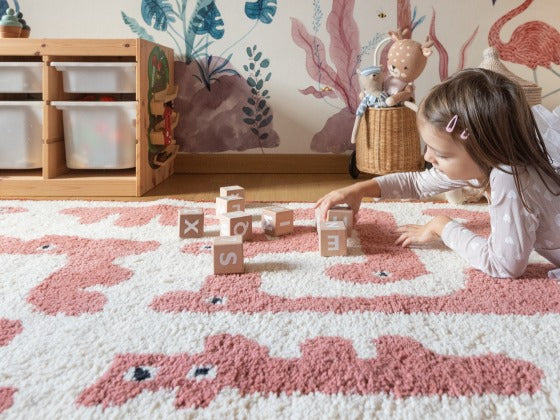
Not categorically, but they do require more attention. A 3–4 cm pile already creates a much thicker layer, even without an underlay. If you want to use a shaggy rug on heated floors, choose one with a natural fabric backing rather than rubber, skip the underlay, and assess whether the overall thickness is reasonable for your system.
What about underfloor cooling: do rugs need to be removed?
Not necessarily, but a little more caution is needed. In cooling mode, the issue is not efficiency so much as possible condensation under the rug. Natural fibres and breathable backing reduce the risk. In summer, especially during the first seasons of use, it may help to avoid covering very large areas and to air the rug regularly.
Our point of view
We at Casa Amar are obviously not neutral. But to us, having a point of view does not mean being less honest. In this editorial space, we always try to be clear, practical and straightforward.
Hand-knotted and hand-woven rugs made from wool and natural fibres are among the most suitable choices for underfloor heating, not because they are somehow “magical”, but because they do not contain the materials that usually create problems: no latex, no rubber, no synthetic backing. They are breathable by nature and by construction.
If you are furnishing a home with heated floors, there is no need to give up rugs. You simply need to choose the right one. Natural fibres, breathable backing and moderate thickness: taken together, those three factors already point you in the right direction.
For everything else — sizing, styles, pairings — we are here. Jihane and Matteo.