









Sometimes, once a bedroom project is finished, you still get the feeling that something is missing. The bed is right, the curtains are in place, the lighting feels balanced… and yet something still feels off.
Is it a missing picture? Maybe the curtains and the bed linen are not working together as well as they should?
More often than not, the most overlooked element is the floor: too bare, too cold, too disconnected from the rest of the room. It lacks character, and with it that sense of warmth and comfort we expect from such an intimate space.
What if what is missing is simply a rug?

A soft long-pile wool rug at the foot of the bed: it defines the area, ties the room together and adds character. Casa Amar rug. Project: Mariana Martini Studio and Fanni Szarvas. Photo by Alberto Rizzieri.
A rug in the bedroom is neither a luxury nor an unnecessary complication. It is one of the furnishing elements that most easily makes the sleeping area feel warmer, more intimate and more personal. After all, of all the spaces in the home, the bedroom is the most intimate: the one where we try to create an atmosphere that genuinely feels like us.
In this guide, we will look at how to choose the right rug without overcomplicating the decision: which sizes really work depending on the type of bed, where to place it, which materials are best suited to everyday use, and how to bring it into the room without weighing the space down.
We will also look at some of the most common questions — from size and colour to care and allergies — always with real life in mind.
Should you put a rug in the bedroom?
The short answer is yes, in most cases.
But since that may sound like a biased answer — given how much we love rugs — it is worth looking more closely at why, and at the situations in which you may genuinely be better off without one.
PROS | Why a rug in the bedroom is often worth it

The bed and armchair are visually linked by an asymmetrically placed rug. Project: Chantal Forzatti Architetto. Photo: Valentina Sommariva.
The most immediate reason is tactile comfort. Stepping out of bed onto something warm and soft in the morning is a small pleasure, but one you feel instantly. This is especially true with ceramic, stoneware or marble floors, where a rug can make a real difference — particularly if there is no underfloor heating.
There is also the question of acoustic comfort. A rug improves the acoustics of the room by absorbing sound and softening that slight echo that can make certain bedrooms feel emptier than they really are. It also helps dampen minor vibrations and noises coming up through the floor, something light sleepers tend to appreciate.
From an aesthetic point of view, a rug helps define the bed area, gives visual weight to the centre of the room and completes the space in a way that few other elements can. It can also help soften or rebalance a floor that feels cold, anonymous or slightly out of tune with the rest of the room — which is especially useful in rented homes with dated finishes that cannot be changed.
Finally, a rug can also have a protective function: on parquet or other more delicate floors, it may help reduce the risk of scratches.
CONS | When a rug may not be the right choice
Is a rug always the right idea? Not necessarily. There are situations in which it can feel unnecessary — or even work against the room.
This is often the case in very small bedrooms, where every visible inch of flooring helps the space feel lighter and less cramped. In those cases, a rug in the wrong size can make the room feel more awkward rather than more resolved.
It can also feel excessive in bedrooms that already contain a lot of textiles, pattern and furniture, where adding another strong visual element risks making the overall scheme feel heavy.
The same applies when the rug gets in the way — for instance, if its edge falls too close to the bedroom door, the entrance to a walk-in wardrobe or the opening to an en-suite bathroom.
And of course, proportion matters. A rug in the wrong size will almost always make the room look less balanced, not more.
Anyone dealing with serious allergies, pets in the home or specific cleaning requirements will also need to think more carefully about the type of rug, the material and the maintenance it will involve. That does not necessarily mean giving up on the idea altogether, but it does mean choosing with greater awareness.
Maintenance should not be ignored either. It is not an enormous commitment, but it does require a basic routine to prevent dust from building up, and that is something worth considering from the start.
How to choose the right size
The most common mistake is choosing a rug that is too small or out of proportion. A tiny “postage stamp” rug tends to disappear and look as though it has been dropped into the room at random. It creates neither balance nor a real relationship with the bed and the proportions of the space.

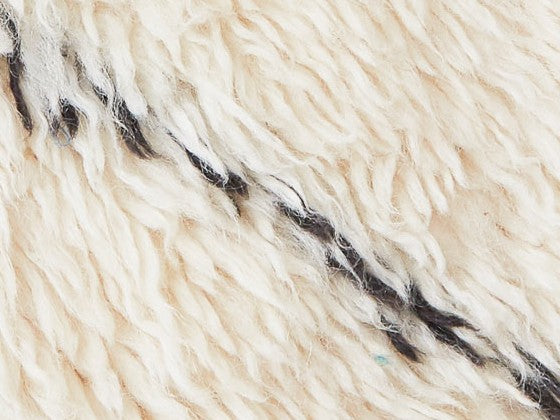
A white-toned bedroom with wood details. The white wool rug is marked by black lines. Project: Nomade Architettura. Photo: Simone Furiosi.
Let’s look more closely at which sizes work best depending on the type of bed, and at the criteria that really help you avoid mistakes.
The basic rule of proportions
There is one simple rule worth keeping in mind: if the rug is going under the bed, it needs to extend far enough to be felt when you step out of bed, as well as to remain visible when you walk into the room.
In almost all layouts, a good minimum reference point is 45–60 cm of visible rug beyond the sides and the foot of the bed.
To make things easier to visualise, here is a quick summary of the most common sizes according to bed type.
| Bed type | Most common rug sizes | Typical placement |
|---|---|---|
| Single | 60×120 cm 70×140 cm 120×170 cm 130×190 cm |
You can opt for a small rug on one side of the bed, or for a larger rug that extends beyond the foot of the bed and gives the room more visual presence. |
| Small double bed | 160×230 cm (or similar medium-size formats) | A rug that starts around the middle of the bed and remains clearly visible at the sides and foot usually works well, without taking over the entire bedside area. |
| Standard double bed | 200×300 cm 240×300 cm 240×340 cm |
It can sit under the lower part of the bed or under the full bed area. If the room is narrow, two side runners or a rug at the foot of the bed can also work well. |
| King size / Super King | 270×360 cm 300×400 cm |
Here, a very large rug is usually the best choice: one that frames the bed properly and remains clearly visible at the sides and foot, creating a stronger, more dramatic effect. |
These measurements are a useful starting point. But to understand whether a rug will really work in your bedroom, what matters most is being able to visualise how far it extends beyond the bed and how it sits within the space.
Recommended sizes for a single bed

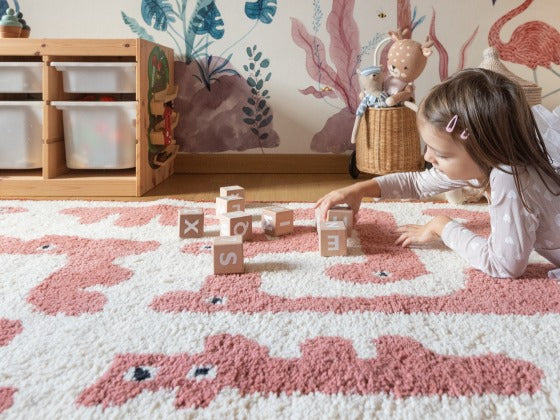
Rug with stylised animals for children’s bedrooms. Animaui Casa Amar x OiMiniDesign Collection.
A standard single bed is generally 190–200 cm long and 80–90 cm wide. There are usually two good options:
- a more practical solution for smaller rooms: a long, narrow runner — for example 60×120 cm or 70×140 cm — placed on the side where you get out of bed;
- a larger rug with more visual presence: something that also extends beyond the foot of the bed, such as 120×170 cm or 130×190 cm. If the room allows for it, the rug can also be larger and placed more centrally, creating a soft play area.
Recommended sizes for a small double bed

In our home in Milan, a very colourful handcrafted rug in a children’s room with a small double bed.
A small double bed typically measures 120–140 cm × 190–200 cm. One of the most balanced choices is a rug around 160×230 cm, which corresponds to a classic medium-size rectangular format.
Placement also depends on where the bed sits within the room: against the wall or in a more central position? Depending on that, the rug can follow a two-thirds layout — starting roughly from the bedside-table line and extending 50–60 cm beyond the foot of the bed — or it can sit alongside the bed or more centrally in the room.
Recommended sizes for a double bed

The runner at the foot of the bed creates a visual passage between the bed and the wardrobe, while also echoing the room’s colour palette. Photo courtesy of one of our clients.
In a bedroom with a standard double bed — in Italy, usually 160 cm wide by 200 cm long — the size of the rug depends very much on the effect you want to achieve.
The most common sizes are 200×300 cm, 240×300 cm, and 240×340 cm.
With a 200×300 cm rug, the lower two-thirds of the bed are usually covered and the rug remains clearly visible at the sides. This is one of the most common and versatile solutions for medium-size bedrooms.
With a 240×300 cm or 240×340 cm rug, the bedside tables and the full bed base can also sit on the rug, with the rug extending visibly on all sides. The effect is very beautiful, but it requires a generous room and plenty of breathing space around the bed.
Two side runners are a valid alternative when the room is compact and the walls sit close to the bed. They can also make sense with underfloor heating, as they avoid covering the entire heated surface.
Recommended sizes for a king-size bed
King-size beds come in different measurements: from the 180 cm width of a classic king-size bed to the 190 cm width of an American king, and up to variations such as 180×210 cm for a California king or 195×200 / 200×200 cm for a super king.
So we are talking about very large master bedrooms, where the bed area can almost become an island in its own right. In these cases, standard rug sizes may simply not be enough to achieve the effect you want.
XL sizes such as 270×360 cm or 300×400 cm can work beautifully here, giving the room a stronger sense of structure and turning the rug into something almost architectural.
The simplest trick to avoid mistakes: mark the rug out on the floor
A very simple way to avoid mistakes — especially when ordering online — is to use masking tape to mark out the outline of the future rug directly on the floor.
It is a quick and practical method that lets you test different layouts before buying, so you can immediately see whether the chosen size feels proportionate, whether it leaves enough room for circulation, whether the bedside tables fit, and whether a storage bed can open properly.
One extra trick: once the tape is down, take a few photos. The room often feels different in a photo than it does in person, and looking at those images with fresh eyes can help you judge whether the choice is truly balanced.
Recap: common size mistakes
Here is a quick summary of the most common mistakes:
- choosing a rug that is too small, so that it appears to float in the middle of the room;
- placing a rug partly under the bed, but leaving so little visible at the sides that it barely registers;
- using runners that are too short, creating something closer to a doormat effect than a deliberate design choice;
- choosing the size in the abstract, without taking into account bedside tables, headboards, doors or drawers;
- pairing runners of different sizes without a clear visual logic behind the decision.
Where to place a rug in the bedroom: layouts that really work
Let’s now look at the four main bedroom layouts, and at the situations in which each one tends to work best.
We have summarised them below, but you can find a fuller explanation in our dedicated guide:

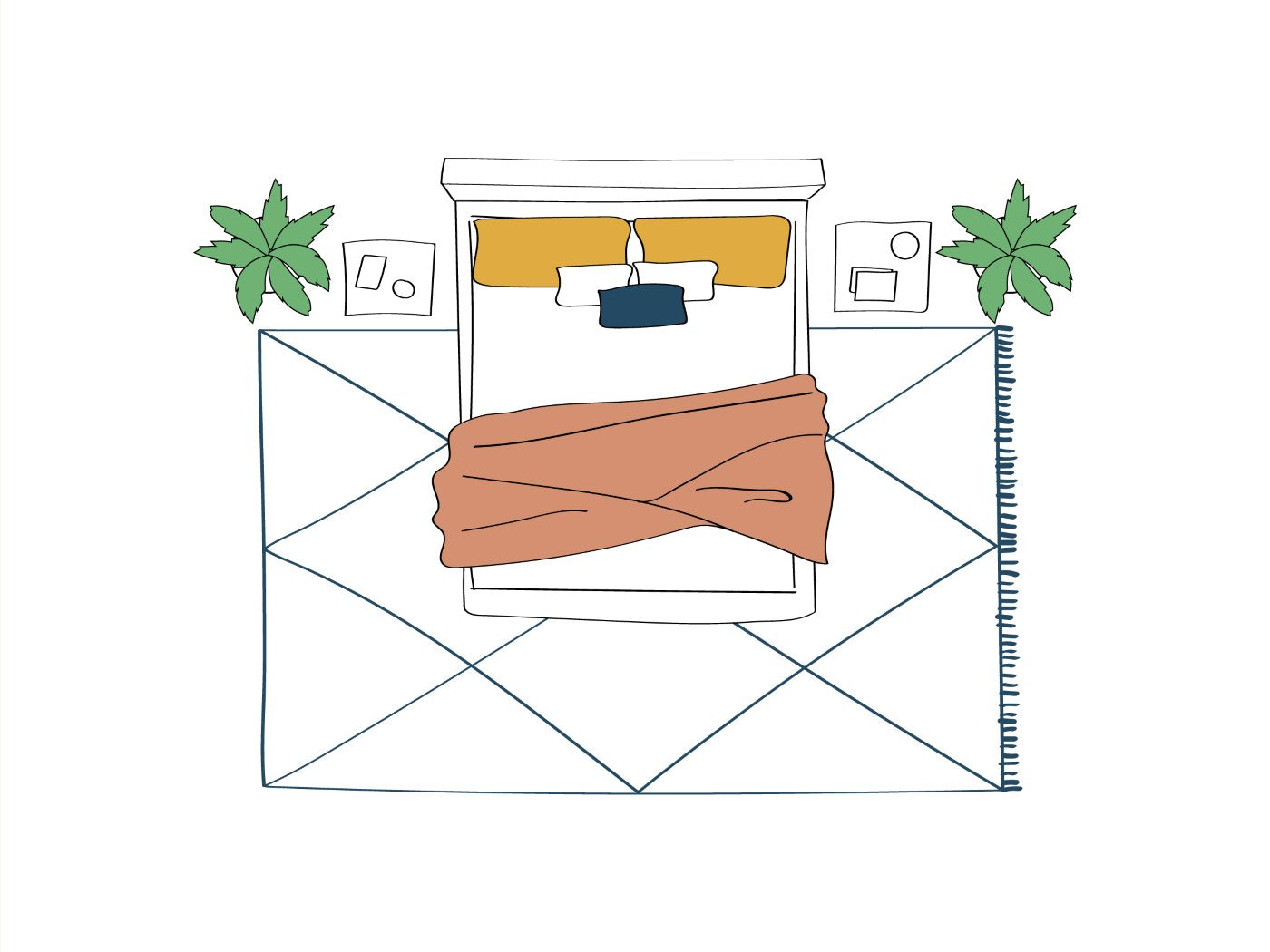
Layout 1: rug under the lower two-thirds of the bed

A bedroom with a modern, minimalist wooden bed and a pink-and-green wool rug with a traditional diamond motif. AI image.
This is the most common layout, and also the most versatile. The rug usually starts around the line of the bedside tables, or slightly lower, leaving the headboard and bedside tables on the floor and extending 50–60 cm beyond the foot of the bed.
It works well with medium sizes, such as 200×300 cm or 240×300 cm, and suits both standard bedrooms and slightly smaller spaces.
It is often the most balanced solution when you want the rug to have presence without becoming too dominant.
Layout 2: a large rug under the entire bed

In creative director Cristina Pettenuzzo’s home, a large hand-knotted rug made from deadstock denim and jeans covers the floor beneath and beyond the bed. Photo: Sylvie Becquet, published in Coté Maison.
In this case, the rug sits under the entire bed base, including the bedside tables. Visually, it is the most cohesive and composed layout, and it gives the room a more polished, deliberate feel.
It requires generous dimensions — typically 240×300 cm or more — and a room large enough to leave at least 50 cm of visible floor around the edges.
It works especially well in large or master bedrooms, and with rugs whose design deserves to be seen in full. In these cases, it becomes even more important to think carefully about pattern, colour and the overall proportions of the room.
Layout 3: two runners on either side of the bed

The wooden bed and soft beige wallpaper are completed by two white wool Beni Ourain runners with the collection’s distinctive black diamond motif. Project: Nomade Architettura. Photo: Simone Furiosi.
This is an ideal solution for narrow bedrooms, for large beds placed in rooms that are not especially well proportioned, or whenever a lighter, more modular result is preferred.
The two rugs — identical or at least coordinated — are placed along the sides of the bed, with common sizes around 60×120 cm, 70×140 cm or 80×150 cm.
They are easier to live with, often more affordable, and visually less intrusive. What matters, though, is securing them with a non-slip rug pad, especially on smooth flooring, as they can shift easily and become a tripping hazard.
Layout 4: a long, narrow rug at the foot of the bed

A bright bedroom in a calm palette of beige, white and blue, with small touches of colour picked up again in the rug at the foot of the bed. Photo courtesy of one of our clients.
It may not be the first layout that comes to mind, but it can work very well in specific situations — for instance, when the room is long and there is enough distance between the bed and the wall, or between the bed and a wardrobe or chest of drawers, to accommodate an additional element such as a bench, a chair or a rug.
In these cases, the rug needs enough depth — at least 80–100 cm — so that it does not feel purely decorative.
Long, narrow runners work particularly well here, provided they are properly proportioned to the bed and to the space around it.
Can you use a round rug in the bedroom?
Why not? It is not usually the first choice under a double bed, since the circular shape can sit a little awkwardly against the straight lines of the bed and the rest of the furniture, but it is by no means out of the question.
It can work well in specific settings: in a large bedroom as a side element, next to an armchair in a reading corner, or in a guest room with a more decorative feel.
If you do choose a round rug, it is better to size it generously: a small round rug left on its own in the middle of the room can easily feel underwhelming.
Materials and comfort: what really changes underfoot
Size and placement matter, but material is what most shapes the day-to-day experience of a rug.
In a bedroom, where you are often barefoot, the choice of fibre and construction matters just as much as the look of the piece — sometimes even more.
Wool: why it works so well in the bedroom
Wool is warm, soft, breathable and durable. Above all, though, it is a material with lasting appeal: it tends to age well, both visually and functionally.

Even a small rug at the foot of the bed can have a strong visual impact when the colours and geometry are right. Project: Alessia Provenzano. Styling and photography: Specchi Studio. Rug designed by OiMiniDesign.
That quality matters especially in the bedroom. Here, the goal is not extreme performance, as it might be in an entrance hall or another high-traffic area, but consistent comfort and a sense of quality over time. Wool usually delivers both with ease.
There is also a practical aspect that is often overlooked: bedrooms tend to see much less foot traffic than the rest of the house. That means a wool rug — even a hand-knotted one — will generally hold up better here than it would elsewhere. With the same level of care, it is likely to keep its look for longer.
Cotton and other natural plant fibres

A bedroom where country, eclectic and minimalist influences come together. A small colourful rug completes the pared-back wooden bed. Project: LasciaLaScia. Photo: Marta D'Avenia.
Cotton rugs are generally easier to live with, which makes them a good option when practicality and low-maintenance living matter most. Cotton is also a more accessible alternative to wool, but that does not make it visually less interesting: depending on the weave, it can still offer pleasing texture and a strong tactile presence.
Alongside cotton, other natural plant fibres that can work well in the bedroom include linen and hemp, both suitable for those looking for something lighter, more natural and visually relaxed.

Layering can work well in the bedroom when you want to combine rustic natural fibres with a softer surface. Photo: La Tazzina Blu.
If you are after a bedroom with a more pared-back, textural or nature-led feel, straw mats can also be an interesting option. They obviously do not offer the softness of a wool rug, but they bring visual freshness, lightness and a very authentic charm. They work especially well in beach houses or in bedrooms shaped by a bohemian, rustic-chic or biophilic aesthetic.
Silk belongs in a category of its own: it is precious, delicate, luminous and highly refined, but for that very reason it requires the right setting and careful handling. In a bedroom, it can work beautifully in particularly sophisticated interiors.
All of these natural materials — silk aside — can also appeal to anyone specifically looking for vegan-friendly options.
Synthetic fibres and viscose: when they make sense in the bedroom
Synthetic fibres are often chosen for their practicality and durability, especially in very modern or minimalist interiors. In a bedroom, they can make sense when ease of upkeep is the priority, or when the desired look depends on very precise surfaces, unusual shapes, tightly controlled patterns or highly graphic designs that are typically achieved through industrial production and high-precision machinery.
Viscose, by contrast, is more decorative in character: it reflects light beautifully, feels fluid and luminous, and can look extremely elegant. It is, however, usually more delicate and less suited to anyone looking for a rug that is easy to care for.
Flatweave, short pile or long pile?
The difference here is not only visual: it really affects how the rug feels and performs in everyday life.

A white wool bedside rug with diamond motifs and graphic lines in warm rust, mustard and grey tones. A soft, decorative presence, perfect for warming up a cosy and textural bedside corner.
Short-pile rugs tend to look lighter and neater, and are usually the easiest to live with:
- they are easier to clean;
- they hold less dust on the surface;
- they feel more stable underfoot.
Long-pile rugs, on the other hand, are all about sensation:
- they feel softer;
- they feel warmer;
- they create a more enveloping, cocooning effect.
They do, however, require a little more care: they flatten more easily under furniture, show wear more quickly, and are less straightforward to clean.
Flat-weave rugs — kilims, hanbels and similar styles — are a lighter and visually subtler option:
- they make the room feel lighter overall;
- they are easier to move around;
- they work well when the rug is not meant to dominate the space.
Because they are lighter, they may also need a rug pad underneath to keep them properly in place.
In the bedroom, the choice ultimately depends on the kind of effect you want: more softness and comfort, more visual order, or a greater sense of lightness. If you are after something easy to live with, short pile and flat weave are usually the most practical options. If what you want is a more enveloping feel, long pile still makes perfect sense, especially in the colder months.
One final note: some people like to change rugs with the seasons. In winter, a thicker and softer rug can add warmth and comfort; in summer, something lighter can make the room feel fresher and visually airier.
If you have the space and the inclination to alternate, it can be a very sensible choice: a warmer, more enveloping rug in winter, and a flat-weave or lighter piece during the warmer months.
If there are allergies or pets in the house
When there are specific needs in the bedroom — for example, someone who is sensitive to dust and mites, or pets in the home — the rug needs to be chosen with even more care.
In these cases, it usually makes sense to opt for something easy to vacuum, not too thick and simple to manage, avoiding very dense constructions if you already know you will not be able to keep up a consistent routine. Size matters too: a smaller, well-maintained rug is often easier to live with than a large textile surface.
Maintenance remains key. In cases of significant allergies or asthma, though, the choice should always be approached with particular caution, ideally taking into account the advice of a doctor or allergist.
Colour, style and how to make a rug work in the bedroom
This is where things get especially interesting: colour, combinations, and the role a rug can play in shaping the overall feel of the bedroom.
Once size, placement and materials are clear, the visual side of the project comes into focus: should the rug lighten the room, warm it up, tie existing elements together, or become the detail that shifts the atmosphere altogether?
How to choose the colour of a rug

A bedroom in shades of white and light wood. At the foot of the bed, a light rug with black diamond motifs. Harmony and light. Project: Alessia Provenzano.
There is no single right colour. What matters is whether the choice feels coherent within the room, rather than impulsive in a way that may become tiring over time.
A simple starting point is this:
- light tones → make the room feel brighter and more open
- mid tones → create balance and help connect the different elements
- dark tones → ground the space and add depth
Below is a quick summary of the main principles, but if you want to go deeper, we have a dedicated guide entirely focused on rug colour and combinations:
At this stage, it helps to ask what role the rug should play in the room. Should it harmonise by picking up colours already present, or should it introduce contrast in a more deliberate way?
Both approaches can work beautifully, as long as they feel intentional.
Other elements matter too: the amount of natural light, the orientation of the room, the colour of the floor, the furniture, and the presence of other textiles — especially the bed linen.
The rug does not need to coordinate with everything. It does, however, need to relate visually to at least one element already in the room. Even a small point of connection is often enough to make the whole scheme feel considered rather than accidental.
Light-coloured rugs: calm, bright and particularly well suited to bedrooms

A farmhouse in the Oltrepò Pavese area, with antique furnishings, a mid-century sofa and a large white wool rug from our collection. Project: LasciaLaScia.
Beige, ivory, ecru, dove grey, warm white… these shades do a quiet but important job in the bedroom: they calm the space, soften it and make it feel more open.
Unlike an entrance hall or living room, the bedroom tends to see far less foot traffic, which means a light-coloured rug is often more manageable than people expect.
Think, for example, of a beautiful Beni Ourain: a creamy white ground, black or grey geometric motifs, medium-to-long pile, and just enough irregularity to keep the surface alive. It does not weigh the room down, but it is far from anonymous; it adds character without becoming loud.
Coloured or patterned rugs: how to use them well
And what if you are drawn to stronger colours or bolder contrasts?

A bedroom in peach tones with a striped and checked bedside rug whose colours echo the wood tones of the bed and the blue of the pendant light. Project: UNDUO Laboratorio di Architettura. Photo: Denise Bonenti.
A good rule of thumb is to start from what is already in the room. A tone in the bed linen, one in the headboard, another in the curtains. The rug does not need to mirror the palette exactly, but it should echo it in some way. One or two shared colours, even just as a subtle thread, are often enough to hold the room together.
An Azilal or a Boujaad, for instance, can become a natural focal point in a bedroom. Vibrant palettes, asymmetrical motifs, and that unmistakable vitality of Moroccan weaving all bring movement and character to the space.
How to combine the rug with the bed, curtains and bedding

A small geometric runner adds rhythm to a bright bedroom with pale wood, white textiles and contemporary details. Project: Alessia Provenzano.
Here is a quick reference to keep in mind:
- Pick up at least one colour already present, even just as a nuance: in the bedding, the curtains, the headboard or a decorative accent.
- Use the rug to warm the room up if the overall scheme feels very neutral or visually cold.
- Avoid layering too many bold patterns, unless there is a clear design intention behind it. It can work, but it is rarely something to improvise.
The goal is not rigid coordination, but a believable visual relationship between the rug and the rest of the room.
Before buying: mistakes to avoid and questions worth asking
When people come to us for advice, we do not just ask about their taste or the atmosphere they want to create. We also ask a few very practical questions. If you are choosing on your own, here is a quick overview of the most common mistakes — and the questions that help prevent them.
Size and placement

The most common mistakes are fairly easy to spot once you know what to look for: choosing a rug that is too small for the bed, or so large that it overwhelms the room; using bedside runners that are too short or too narrow; placing the rug without checking its proportions within the space; or picking a design that ends up mostly hidden under the bed and therefore loses much of its effect.
Ask yourself: Do I want the rug for comfort underfoot when I get out of bed, for visual impact beneath the bed, or only at the foot of it? Have I marked out its shape on the floor with tape — and taken a few photos to look at it with fresh eyes? Will enough of the rug remain visible, or will most of it disappear under the bed? Have I checked all the practical constraints: a storage bed, drawers, doors, bedside tables, or underfloor heating?
Material
Another common mistake is choosing purely on appearance, without considering whether the material will actually feel right underfoot. The same goes for overlooking maintenance, allergies, pets, or the practical realities of the room. Rugs that are too thick near drawers or low storage units can become awkward very quickly, and focusing too much on whether something is “washable” can distract from more important questions of comfort, look and long-term livability.
Ask yourself: Does this material suit the way I really live, rather than the way I imagine I live?
Style and colour
It is also easy to overdo things visually: too many bold patterns in the same room, very dark colours in a space with little natural light, or a rug that does not relate to anything else in the scheme. Another common trap is aiming for a showroom-like result that looks good in theory but feels disconnected from daily life.
Ask yourself: Does the colour connect with at least one element already present in the room?
If you can answer these questions clearly, you have already avoided most of the mistakes people tend to make.
FAQ – Frequently asked questions
Where should I place a rug in the bedroom?
It depends on the size and shape of the room, as well as the effect you want to achieve. In larger bedrooms, a rug can sit under the entire bed, including the bedside tables, for a more island-like layout, or under the lower two-thirds of the bed, leaving enough rug visible at the sides and foot. In smaller or narrower bedrooms, two bedside runners or a runner at the foot of the bed often work better, especially if there is a bench, a wardrobe or a chest of drawers nearby.
What size rug do I need for a double bed?
A 200×300 cm rug is one of the most common choices and usually works well under the lower two-thirds of a double bed. A 240×300 cm or 240×340 cm rug, by contrast, can also accommodate the bedside tables and create a fuller, more cohesive effect, provided the room is spacious enough.
How far should a rug extend beyond the bed?
As a general rule, the rug should extend at least 45–60 cm beyond the sides of the bed and at least 60 cm beyond the foot. Less than that, and even a technically correct size can end up looking too small.
Is one large rug better than two smaller ones?
If the room allows for it, one large rug usually creates a more cohesive and visually grounded result. Two runners on either side of the bed tend to work better in narrow bedrooms or when you want something lighter, more flexible and often more budget-friendly.
Short pile or long pile?
Both can work well in a bedroom, where foot traffic is usually limited. Short pile is generally easier to live with and simpler to clean, while long pile feels warmer, softer and more enveloping, but also requires more attention. The right choice depends on the effect you want and on how much maintenance you are realistically willing to take on.
Does a rug collect dust?
Yes — like any textile surface, a rug will collect dust. What makes the difference is the material, the construction and, above all, the way it is cared for. In a well-kept bedroom, with regular vacuuming, it is often easier to manage than people assume, but it should not be ignored.
Can I have a rug in the bedroom if I suffer from allergies?
The honest answer is: it depends. It depends on the type of allergy, the material, the construction of the rug and how regularly it can be maintained. In the case of significant allergies or asthma, the choice should be approached with particular care, ideally taking into account the advice of a doctor or allergist.
Can I use a round rug in the bedroom?
Under a double bed, a round rug is rarely the most effective option. As a side element, though — next to an armchair, for example, or in a reading corner — it can work beautifully. The main thing is to choose a generous enough size, because a round rug that is too small can easily feel lost in the room.
What is the best material for a bedroom rug?
Wool remains one of the strongest options: it is warm, soft, breathable and durable. In a bedroom, where wear is limited, it also tends to age particularly well. If you are after something more practical, a flat-weave rug in wool or cotton can also be an excellent choice.
Is a rug suitable for parquet or underfloor heating?
Yes, as long as you choose carefully. On parquet, it is best to avoid rubber backings that may leave residue over time. With underfloor heating, it makes sense to avoid rugs that are too thick or overly insulating. For a fuller explanation, it is worth reading the dedicated guide.
Where to find the right rug if you do not want to choose at random
By the end of this guide, one thing should be clear: choosing a rug for the bedroom is not a minor decision.
The difficulty today is not a lack of options, but quite the opposite. Too many rugs look right on paper, then fail to work in a real room because of their size, material, visual impact or maintenance needs.
To choose well, a few things matter more than endless choice: clear information on materials, technique and origin, reliable imagery, attention to real-life proportions, and a selection that still makes sense once the rug leaves the screen and enters an actual home.
In our shop, you can start from a selection of bedroom rugs and runners designed to help you narrow things down more thoughtfully, rather than simply scroll through endless alternatives.
The right rug is not the one that looks best in a photo. It is the one that, once in place, makes the room feel complete, welcoming and more your own.
Guides and articles that might interest you:
How to place rugs at home [with practical room-by-room examples]How to choose the rug colour and match it room by room
How to choose, use, and clean wool rugs
🤍 Finally, a heartfelt thank you to all the designers, architects and studios who choose us for their projects. Seeing our rugs find a place in spaces that are so thoughtful, varied and beautifully put together remains one of the most meaningful parts of our work.